

For several weeks the general public press has been raving about the occurrence of a “Super” El Niño, which could be “the most intense in the last ten years”, could “make 2027 the hottest year on record », or even “the scenario that is emerging for 2026 could be the most violent ever seen ».
I know the press loves sensationalism and disaster scenarios, but let's keep a cool head in this media heat-up. While predicting the rapid return of an El Niño episode in the second half of the year 2026, some scientists are more measured in their assessment of the probabilities of development of the phenomenon while others, on the other hand, are worried about it.
The World Meteorological Office
 March, the latest monthly newsletter WMO report on global climate trends signals a clear change in the equatorial Pacific : sea surface temperatures are rising rapidly, suggesting a likely return of El Niño conditions from May-July 2026. Forecasts indicate a “near-global predominance of above-normal land surface temperatures” over the next three months, as well as regional variations in the distribution of precipitation.
El Niño episodes influence temperature and precipitation patterns in different regions and generally have a warming effect on global climate. Thus, 2024 was the hottest year on record due to the combination of a powerful episode El Niño in 2023-2024 and human-caused climate change linked to greenhouse gases.
However, there is no evidence yet that climate change increases the frequency or intensity of El Niño events. But it can amplify their impacts, as warming of the ocean and atmosphere increases the availability of energy and moisture for extreme weather events such as heat waves and heavy precipitation.
NOAA Climate Prediction Center
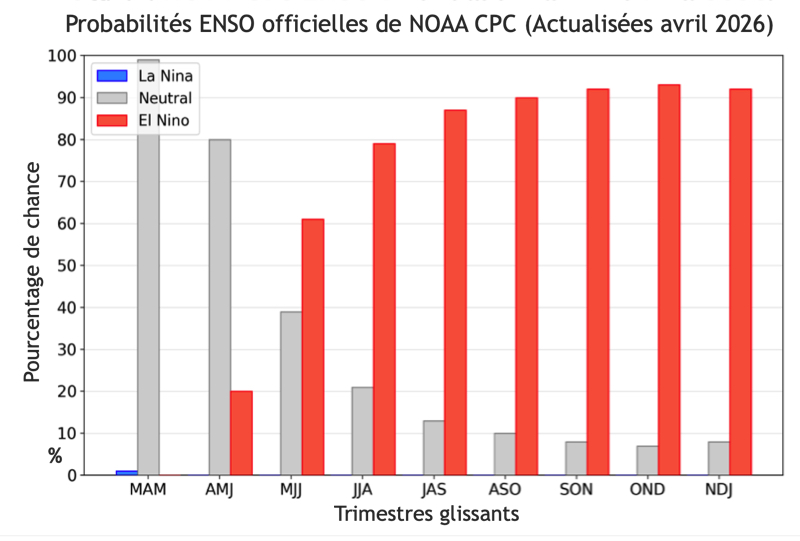
 In its report on April 27 th, CPC observes current ENSO neutral conditions. Equatorial sea surface temperatures (SST) are near or above average in the east-central Pacific Ocean. These ENSO neutral conditions are expected from April to June 2026 (probability of 80 %). In May-July 2026, El Niño expected to appear (probability of 61 %) and persist at least until the end of the year 2026.
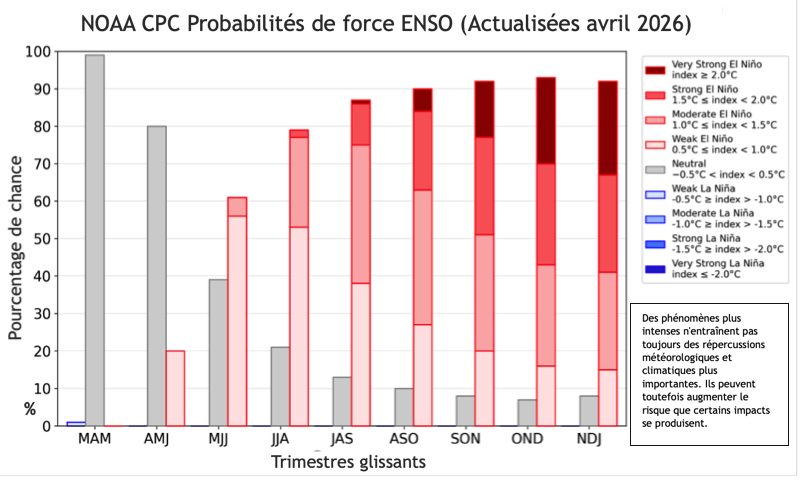
CPC forecasts of likely ENSO intensity, updates on April 9 th 2026, are moderate : between November 2026 and January 2027, the chances of a very strong El Niño phenomenon, strong or moderate, occur are practically equivalent (25 %).
Copernicus models – ECMWF
 At Climate Change Service (C3S) of the Copernicus division of the European Center for Medium-Range Weather Forecasts, the language is more alarmist. The month of March 2026 recorded the second highest sea surface temperature (SST) the highest ever observed, behind mars 2025, reflecting a likely transition to El Niño conditions, as reported their latest climate bulletin. Strong or very strong El Niño conditions could contribute to another record year, warmer surface waters of the equatorial Pacific releasing more heat into the atmosphere.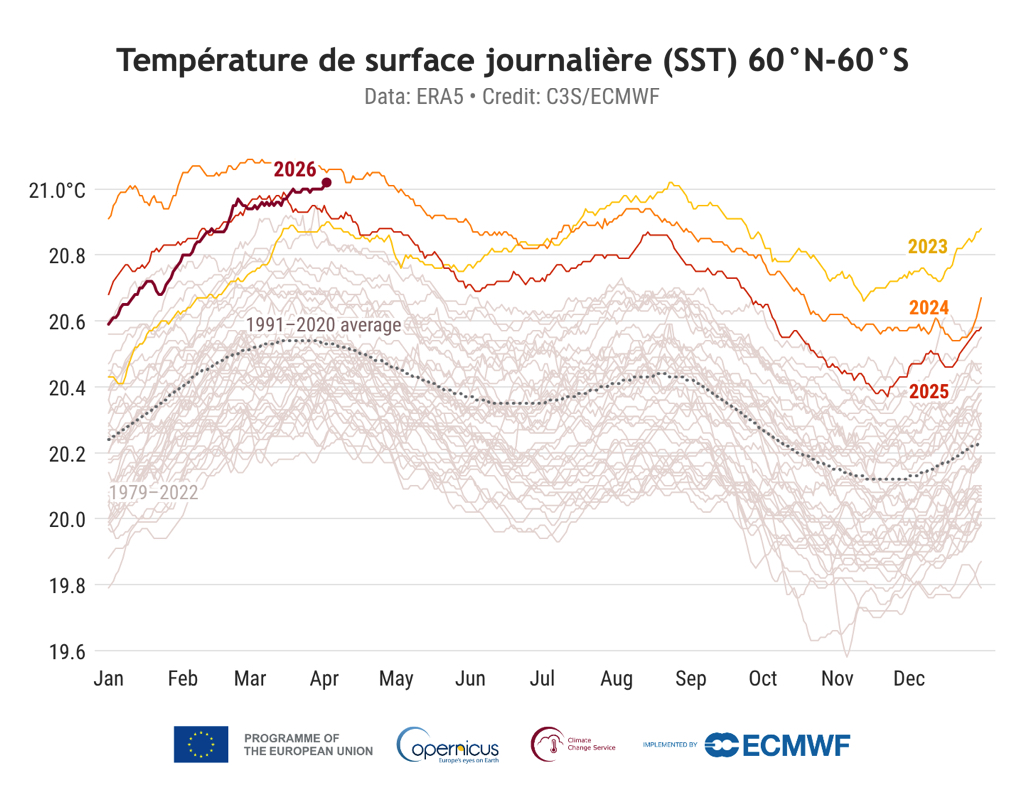
Carlo Buentempo, the director of C3S, shared his concern in these terms :
Copernicus data for March 2026 tells a sobering story : up to 1,48 °C above pre-industrial levels, the lowest Arctic sea ice extent on record for March, and sea surface temperatures again approaching historic highs. Each figure is striking on its own ; together, they paint a picture of a climate system under sustained and accelerating pressure. Reliable data, produced operationally from billions of measurements across satellites, ships, aircraft and weather stations, is no longer a scientific luxury. It is the essential foundation for any serious climate adaptation and policy response. ”
It is therefore difficult to decide between the divergent assessments of scientists. Personally, I prefer to err on the side of caution and follow developments on specialized scientific websites rather than in the mainstream press. We already have many other immediate concerns, it seems pointless to add more.