
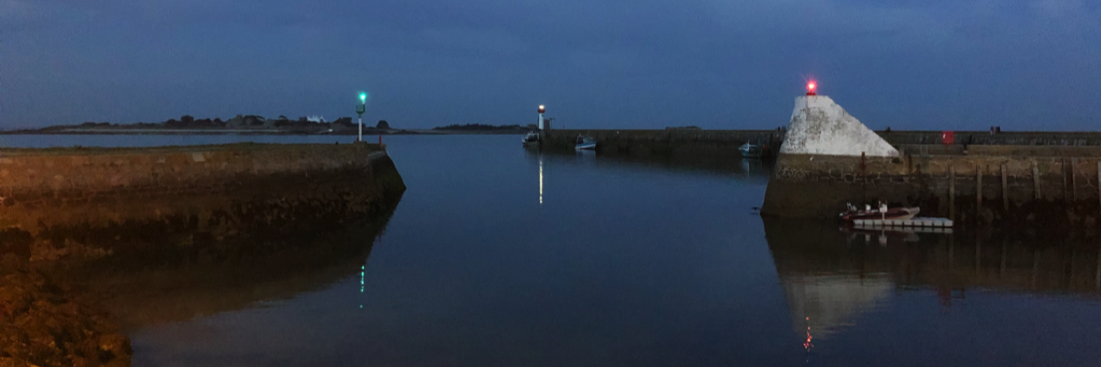
Weather and ocean data In-situ are observational data broadcast in real time, or quasi-real, from different sources : semaphores, ships at sea, fixed or drifting buoys, airports, and also specialized satellites. This data is available as open data to the general public and also for reuse by the economic sphere.. The new NavimetriX application allows you to display this data to complete the forecasts of models distributed in GRIB format.
Semaphores along the coasts
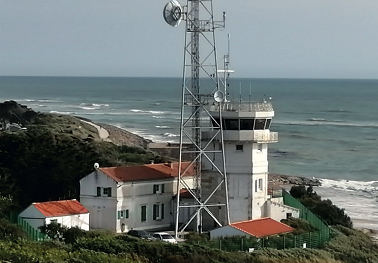 The National Navy maintains in activity 55 semaphores along the French coast. They carry out numerous territorial surveillance and navigation safety missions.. Among others : ship alerts, broadcast of weather reports and AVURNAVs on VHF, maritime traffic regulation, falls under regulatory infractions, aso. Some carry out a specific mission of collecting and disseminating meteorological measurements.
They are divided into two categories : the first 24/7 watch, the second watch from sunrise to sunset. We find :
- On the Atlantic coast, 25 semaphores from Mont-Saint-Michel to the Spanish border,
- On the coast of the Channel, 12 semaphores from the Belgian border to the bay of Mont-St-Michel,
- In the Mediterranean, 18 semaphores on the mainland coasts and Corsica.
Ships and weather buoys at sea
Meteorological observation data are carried out and broadcast every hour by the French selected ships for mainland France and overseas. They also come from messages SHIP et BUOY circulating on the global telecommunications system (SMT) of the World Meteorological Organization (WMO).
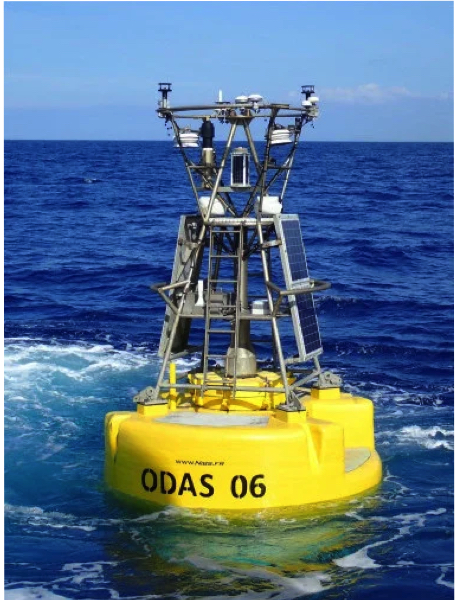 Fixed data acquisition buoys type ODAS, or drifting, provide hourly weather and sea state measurements. Météo-France has approximately 70 drifting buoys deployed and operational distributed between the Atlantic and the Indian Ocean, and 10 fixed ODAS buoys, one off the coast of the Antilles, on funds of 5.500 meters, one in the Bay of Biscay by a bottom of 4.500 meters, and eight in the Western Mediterranean (¹).
Airports on land
The control towers of all airports broadcast ground weather observations every hour or every half hour., the METAR, usually including a trend forecast.
Weather satellites
Meteorological satellites now make it possible to collect wind data on the ocean surface in near real time..
 ASCAT – Advanced Scatterometer.
These microwave sensors are on board satellites EUMETSAT (²) METOP-B and METOP-C. They are capable of systematically providing measurements across the entire globe. The sensors, operating at radar-like frequencies can make measurements on the ocean surface day or night and in almost all weather conditions :
- Surface winds at 10 meters, speed and direction, 0.5° resolution (30 NM) et 0,25° (15 NM)
- Storm data
- Ice data
This information is processed by the NOAA / NESDIS (³). A Europe, the KNMI (⁴) is responsible for ASCAT wind products.
NavimetriX
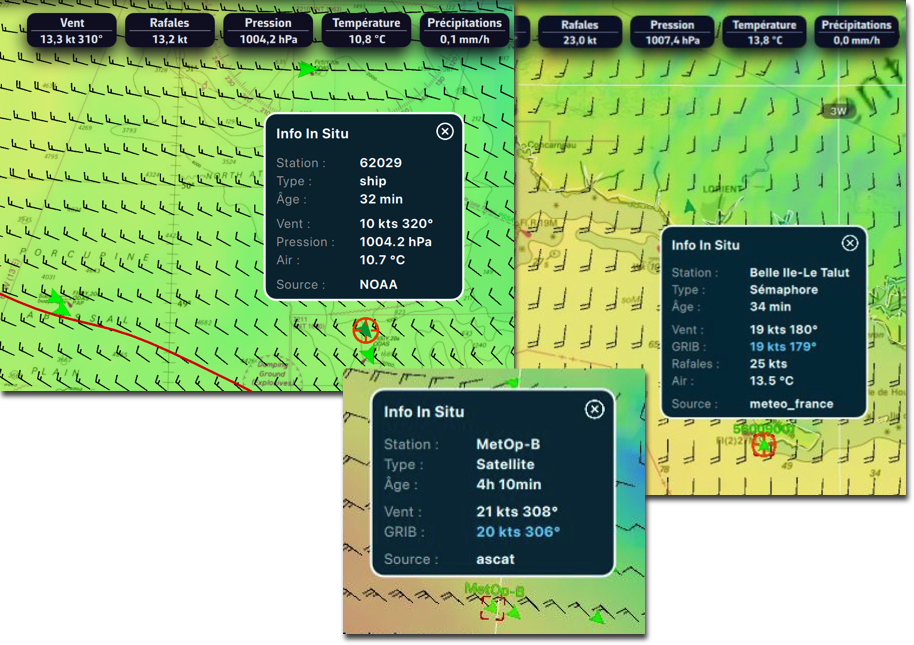
Displaying measurements from these stations allows readings to be compared with model forecasts at their position., and thus verify its accuracy.
–––
(¹) Météo-France strengthens its observations in the Mediterranean [Update]
(²) https://www.eumetsat.int/metop-sg
(³) https://www.nesdis.noaa.gov
(⁴) Royal Netherlands Meteorological Institute
–––
This means that an Iridium Go will be enough to use the weather tools in Navimetrix. ?
No, pas l’Iridium GO! because it does not allow you to connect to the internet. I mentioned in my response to a comment from 16/12 : Iridium GOexec, Starlink, soon Amazon Leo, even other systems to come.
Thank you for the description of these weather tools. But the article does not specify how Navimetrix recovers them. Should we assume that we have a permanent Internet connection at sea? ?
An internet connection is actually necessary to reach our servers, because this cannot be the subject of downloaded data.
Coastal cellular connection, offshore satellite (Iridium GOexec, Starlink, soon Amazon Leo,…).