

 With the brand new update 1.9 NavimetriX brings, among other new features, a high-level routing function : the overall routing.
GEFS
The Global Ensemble Forecast System (GEFS) is a weather model created by the National Centers for Environmental Prediction (NCEP) from NOAA which generates 30 separate weather forecasts — called ensemble members — and a forecast called a control run, to address underlying uncertainties in input data, such as limited coverage, the biases of instruments or observation systems, and the limits of the model itself.
It is updated every six hours and, from 2020, with a range of 35 days for run 00Z (¹).
Ensemble routing
Routing consists first to download the GEFS model like any GRIB model. Then we launch the routing in NavimetriX which will calculate 30+1 routings from model members. We obtain a bundle of “spaghetti” around the control run.
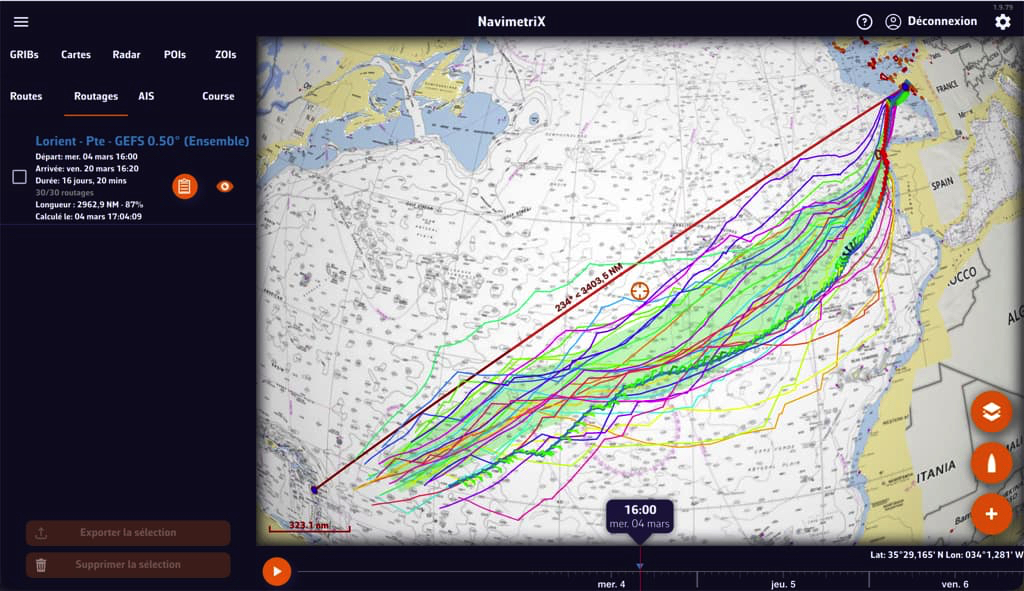
Interpretation
• The confidence corridor
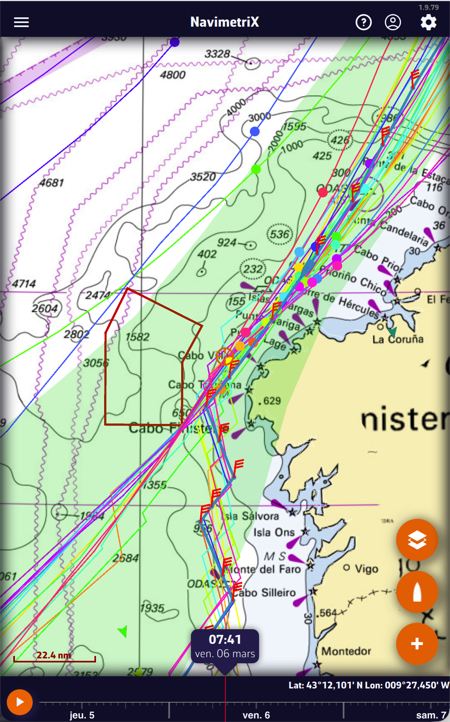 An area is displayed in the middle of the routes, colored green, representing the standard deviation, i.e. the statistical spread ± 1 of different routings around the average. About 68% routes are located within this corridor. The members furthest from the average are removed from the calculation.
The narrower the corridor, the more reliable the optimal route inside, the wider it is, the more uncertainty grows with the dispersion of members. Beyond 4 to 5 days generally the dispersion increases and the corridor widens. In practice, we take this consensus area into account to guide our route.. As soon as a new updated GEFS is available, we restart the routing calculation.
In the screenshot opposite, we see the majority of members converging close to land from the TSS.
• Routing statistics
Navimetrix provides an ensemble routing table bringing together the different data.
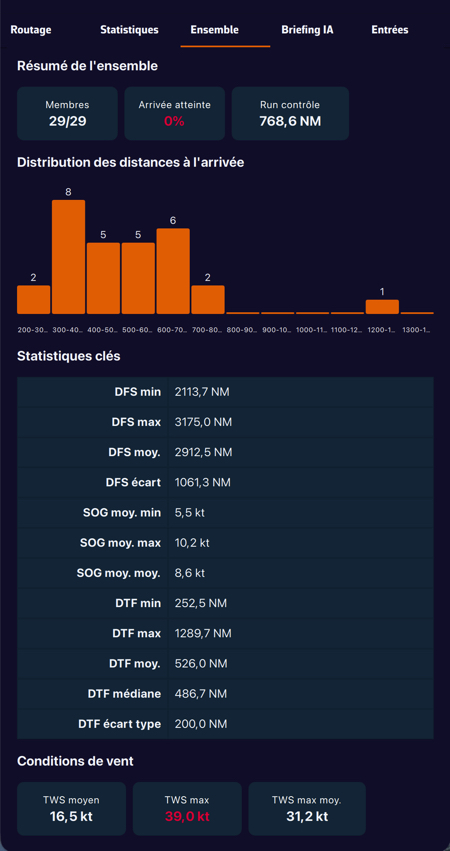
- Summary :
- Number of members used.
- Percentage of arrival reached.
- Control run : distance to arrival.
- Distribution of distances to arrival (Arrivals < 100%) :
- Histogram of the number of members by distance to arrival.
- Distribution of navigation times (Arrivals = 100%) :
- Histogram of the number of members by time steps.
- Key statistics (Arrivals < 100%):
- DFS (Distance From Start) min/maxi/mean/spread, if not arrived.
- SOG average. min/maxi/medium
- DTF (Distance To Final) min/max/mean/median/spread
- Key statistics (Arrivals = 100%):
- Minimum/maxi/mean/standard deviation duration.
- ETA at the earliest/latest
- Control run duration
- Ensemble average duration
- Wind conditions :
- TWS average/maxi/average max
Usage
Beyond four or five days, the reliability of low-resolution weather models decreases and ensemble routing makes allows us to form an opinion on the appropriateness of a trajectory., compared to traditional routing, by observing in the long term the convergence or divergence of the members of the ensemble. It is also a decision-making tool for planning a wise departure, particularly in highly unstable weather systems.
No need to look for the member arriving first, but rather inside the confidence corridor look for the members who have a majority consensus. Also display the wind and pressure spreads on the chart to identify areas of high uncertainty.(²).
–––
(¹) GEFS Products
(²) How to launch and interpret an ensemble routing
–––