
The new AIS AIT5000 transponder (from Digital Yacht) increases transmission rate depending on ship speed.
A new generation of transponder (¹) AIS Class B+ claims to make pleasure boats more visible. Here's how… Read more …
La navigation maritime multi-supports multi-OS

The new AIS AIT5000 transponder (from Digital Yacht) increases transmission rate depending on ship speed.
A new generation of transponder (¹) AIS Class B+ claims to make pleasure boats more visible. Here's how… Read more …
 I relay here an article published in 2014 on the blog of Digital Yacht which provides an excellent discussion on choosing which antenna to install for an AIS transceiver. Below you will find a transcription freely adapted by me..
One of the most common questions asked by boaters who want to purchase a Class B AIS transponder is : which VHF antenna to use ? Read more …
 If you navigate with an iPad and enjoy mobile navigation, and if you like listening to music for dancing on the waves, you may be interested in mobile Hi-Fi.
The well-known manufacturer Bose has designed small Bluetooth speakers, the SoundLink MicroBT, compact and completely waterproof, perfectly suited to nomadic use, and so to the boat. I tested and adopted.
For all browsers who are new to using an iPad, and who do not yet know the basics of manipulation. For everyone who asks me :
 Ultrasonic anemometers-weathervanes for yachting came up just over 15 years old. Among the best known we can cite those of the American Airmar and French LCJ Sensors. Equipped with sophisticated electronics, these sensors without moving mechanical parts have the double advantage of being much more robust than traditional sensors, and provide much more precise data. They can also integrate other sensors as a barometer, gyroscope, electronic compass and sometimes even GPS.
The first ultrasonic sensors were equipped with a cable for power and data transfer. The manufacturer LCJ Sensors, building on the success of its CV3F sensor marketed since 2001, designed the CV7SF range, wireless models whose data is transmitted over a radio frequency to a receiver which converts it to NMEA (0183 or 2000). Power is supplied by solar cells on the sensor cap, and different output connection interfaces are offered depending on the models.
A new actor, Spanish Calypso Instruments, has just designed a completely new concept wireless sensor, the Calypso Ultrasonic Portable, whose characteristic is to be featured with a Bluetooth Low Energy Transmission Protocol (Bluetooth 4.1), which offers many advantages.
 I introduced last May The Nomad, a portable AIS transceiver designed by Digital Yacht. I had to wait until the end of the summer to have the opportunity to test in real situation this device that had been entrusted to me by the manufacturer. I can already say that I was conquered.
I conducted the test in two phases. The first in my home port of St-Vaast-La-Hougue in my own boat, to the pontoon, and at low tide, the port doors closed - the context is important - for the commissioning of the reception only. The second at sea, in Roussillon, with setting the transmission service. Read more …
 Among the many new features brought by iOS 11, I particularly appreciated the improvement in the multitasking functions. The addition of a retractable "Dock" in the MacOS way, the "SlideOver" function combined with the "SplitView" function already present in iOS 10. This will greatly improve the use of navigation apps. Read more …
 Good news, a year after its appearance on the first smartphones (¹), Apple finally integrates a GNSS receiver chipset compatible GALILEO. The iPhone 8/8+ and soon iPhone X are now equipped with the Snapdragon X16 LTE modem MDM9655 from Qualcomm, which includes a multi-GNSS receiver : GPS (USA), GLONASS (Russia), GALILEO (Europe) and QZSS (Japan) (²).
[Update 15/12/2017] The iPhone 6S and 7 are now compatible with Galileo signals.

[Update 15 February 2019] The recent update of the application Iridium Mail & Web app gives me the opportunity to refresh this post originally written in December 2011.
The Wi-Fi Gateway Optimizer from RedPort allows owners of a mobile satellite phone to make requests and receive GRIB weather files from an iPad or iPhone on the high seas, into the wild, anywhere on the world.
After implementing and testing this solution On a long journey, It proved to be perfectly operational. However, it is limited to the receipt of the forecasts of the GFS weather model worldwide, and the wave pattern WW3, obtained by the American server's autoresponder Saildocs.
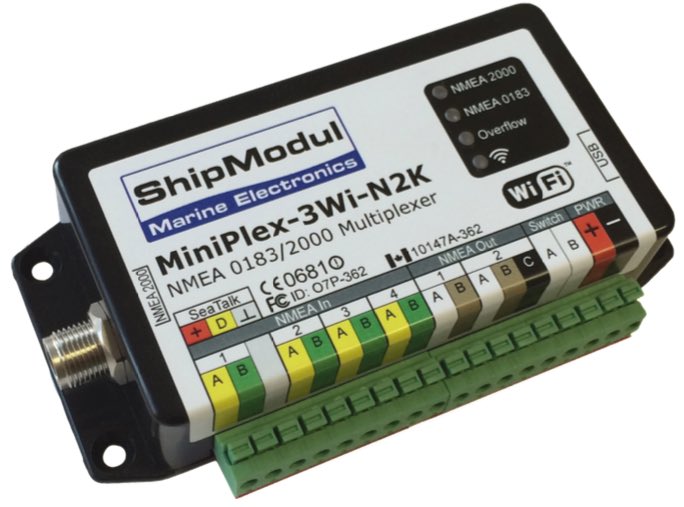 ShipModul has just made a major update V.2.0.6 of MiniPlex-3 firmware. Once installed in the MiniPlex-3-N2K, it becomes a certified product NMEA2000®. To perform this update, It is imperative to download and install the new version of the utility MPX-Config3 V.2.4.1 (¹). the firmware update is integrated into the utility package. Read more …